SHENZHEN GC ELECTRONICS CO.,LTD
consumer electronic products & accessories



Rovva RV50D Heavy-Duty Remote Control Cargo Rover
- Product: Remote Control Cargo Rover
- Model Number: RV50D
- Measurement: 450*866*400mm
- N.W.: 40KG
- Parameters
- Product: Remote Control Cargo Rover
- Model Number: RV50D
- Measurement: 450*866*400mm
- N.W.: 40KG
JMRRC Rovva RV50D Heavy-Duty Remote Control Cargo Rover Agricultural RC Vehicle Platform Max Supporting 100KG Weight
Product Overview:
The Rovva RV50D is a versatile, low-speed remote-controlled agricultural utility platform
engineered specifically for small farms, greenhouse operations, and family agricultural settings. This compact workhorse serves as a modular carrier that can be equipped with various attachments to address diverse farming needs—from crop protection spraying to
material transport and vegetation management.
engineered specifically for small farms, greenhouse operations, and family agricultural settings. This compact workhorse serves as a modular carrier that can be equipped with various attachments to address diverse farming needs—from crop protection spraying to
material transport and vegetation management.
1- Modular Versatility for Year-Round Utility
The RV50D's open-platform design enables rapid attachment changes to suit seasonal farming needs:
Spraying Operations: Equip with tank and boom sprayer systems for efficient crop protection applications in greenhouses, vegetable fields, and orchards.
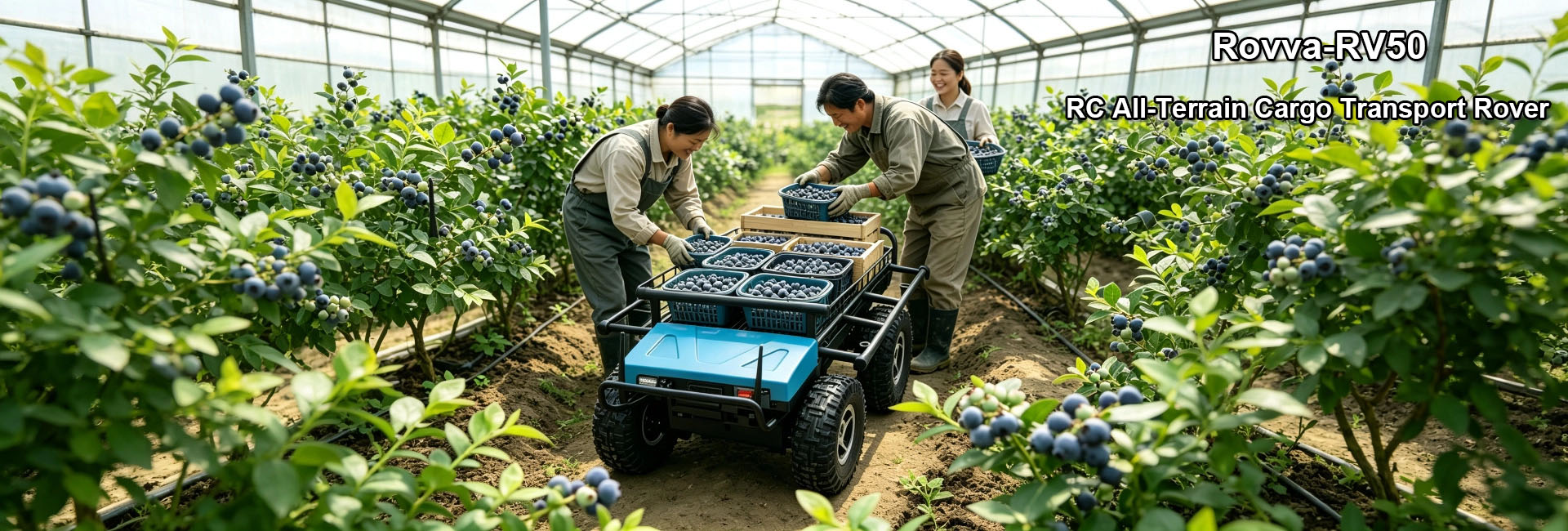
Material Transport: Swap to cargo racks for hauling fertilizers, harvested produce, or farm supplies between field locations.
Vegetation Management: Attach mowing equipment for pasture maintenance, field clearing, and weed control
The RV50D's open-platform design enables rapid attachment changes to suit seasonal farming needs:
Spraying Operations: Equip with tank and boom sprayer systems for efficient crop protection applications in greenhouses, vegetable fields, and orchards.
Material Transport: Swap to cargo racks for hauling fertilizers, harvested produce, or farm supplies between field locations.
Vegetation Management: Attach mowing equipment for pasture maintenance, field clearing, and weed control
2- Material & Harvest Transport
Leveraging its 60kg payload capacity and ≤25% climbing ability, the RV50D serves as an efficient 'last-meter' logistics solution within fields and growing areas. It transports freshly picked fruits and vegetables, carries fertilizers, and moves farm tools or supplies between plots. Its 4-wheel independent drive and narrow profile allow it to maneuver through tight crop rows with minimal ground disturbance, significantly reducing crop damage compared to conventional tricycles or utility vehicles.
3- Slope & Complex Terrain Work
Thanks to its dual-motor electromagnetic braking system and powerful 4WD drivetrain, the RV50 performs reliably on sloped orchards and uneven field surfaces. It can securely park on inclines without rolling, making it suitable for terraced orchards, hillside vineyards, and other challenging agricultural landscapes where conventional wheeled equipment struggles.
In summary, the positioning of the RV50D is clear: it is not intended to replace large harvesters, but rather to address the scattered, repetitive tasks in greenhouses and orchards where 'machines cannot enter, labor costs are high, and the environment is too harsh'.


Previous : 70L Track Tank Pesticide Spraying Robot Car Irrigation Vehicle Streets Cleaning Robot
Next : RV50 Agricultural Spraying Robot


 Copy product links
 Long by picture save/share
INQUIRY

Add Successfully
INQUIRY
Add Successfully